


Sony’s announcement that it will stop producing physical discs for new PlayStation games starting in January 2028 reads like a company pulling the plug on a format. The sales data says otherwise: the plug had already come out years earlier, and Sony is simply acknowledging what Circana’s tracking has shown for over a decade. According to analyst Mat Piscatella, only two PlayStation titles sold more than 10,000 physical copies in the US during the week ending July 11, 2026, and just seven games crossed the 100,000-unit mark for the entire year to that point. In 2008, roughly 100 different games passed that same threshold.
The scale of the drop is the real story. US physical game sales peaked at 297 million units in June 2009; the most recent 12-month tracking period counted 37 million, an 87% decline. Spending on physical games peaked near $11.5 billion that same year and has fallen to about $1.6 billion, after sixteen consecutive years of decline broken only by a brief 4% uptick. The best-selling physical PlayStation release of 2026 moved roughly 275,000 copies, a number that would barely have registered as a mid-tier release in the Blu-ray era.
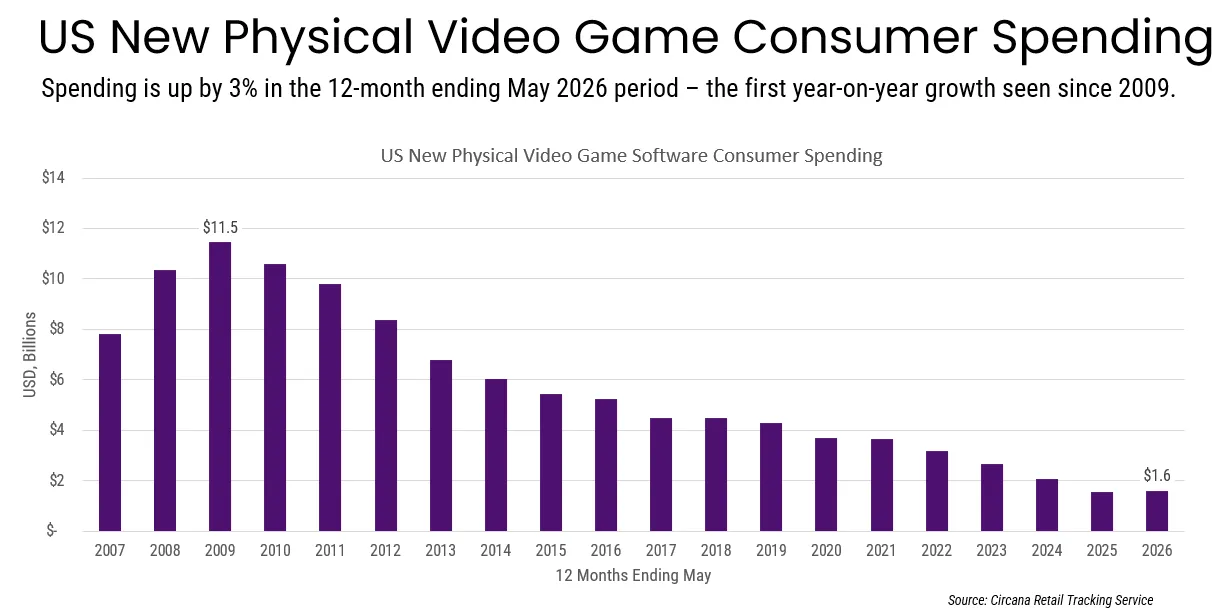
Part of the collapse is mechanical rather than cultural. Once developers began requiring full installs to a console’s hard drive to compensate for slow optical read speeds, the disc in the tray stopped being a data source and became a license check, largely idle while the game actually ran from local storage. Optical discs were adapted from formats built for linear playback, music and film moving front to back. Games read unpredictably, jump between assets constantly, and need near-instant access, which is precisely what spinning media is worst at and what solid-state storage handles by design.
Sony’s own figures point to a split rather than a disappearance of physical hardware. The company has said digital purchases made up roughly 78% of PS5 software sales in the last fiscal year, rising to 85% in the fourth quarter, even though more than 80% of PS5 consoles ever sold are the disc-drive edition, not the digital-only model. Xbox shows a similar but more advanced pattern, with 52% of Series consoles sold in the digital-only configuration. People are still buying drives; they have largely stopped buying what goes in them. In its own announcement, Sony framed the change as following “consumer preferences and the broader entertainment industry” shift away from discs, and said games already released or scheduled before 2028 are unaffected.
The reaction has been loud without being large. A Change.org petition opposing the shutdown drew fewer than 400,000 signatures, and developers including Nier: Automata director Yoko Taro and Disgaea creator Sohei Niikawa publicly objected, but nothing in the data suggests a market correction is coming. What the numbers don’t settle is what happens outside the US and UK, where physical sales still hold more weight in markets like Japan, or what becomes of backward compatibility and collector’s editions once new discs stop being pressed at all. TekCrispy has covered the deeper problem underneath this shift: when Sony pulled 551 licensed titles from UK PlayStation libraries in June 2026, or when Ubisoft shut down The Crew and left 12 million copies unplayable, it wasn’t a hypothetical about discs disappearing — it was a demonstration of what “owning” a digital copy already means. Sony didn’t kill the PlayStation disc. It stopped paying to manufacture something almost nobody was buying anymore.
Discover more from TekCrispy
Subscribe to get the latest posts sent to your email.

 TekCrispy